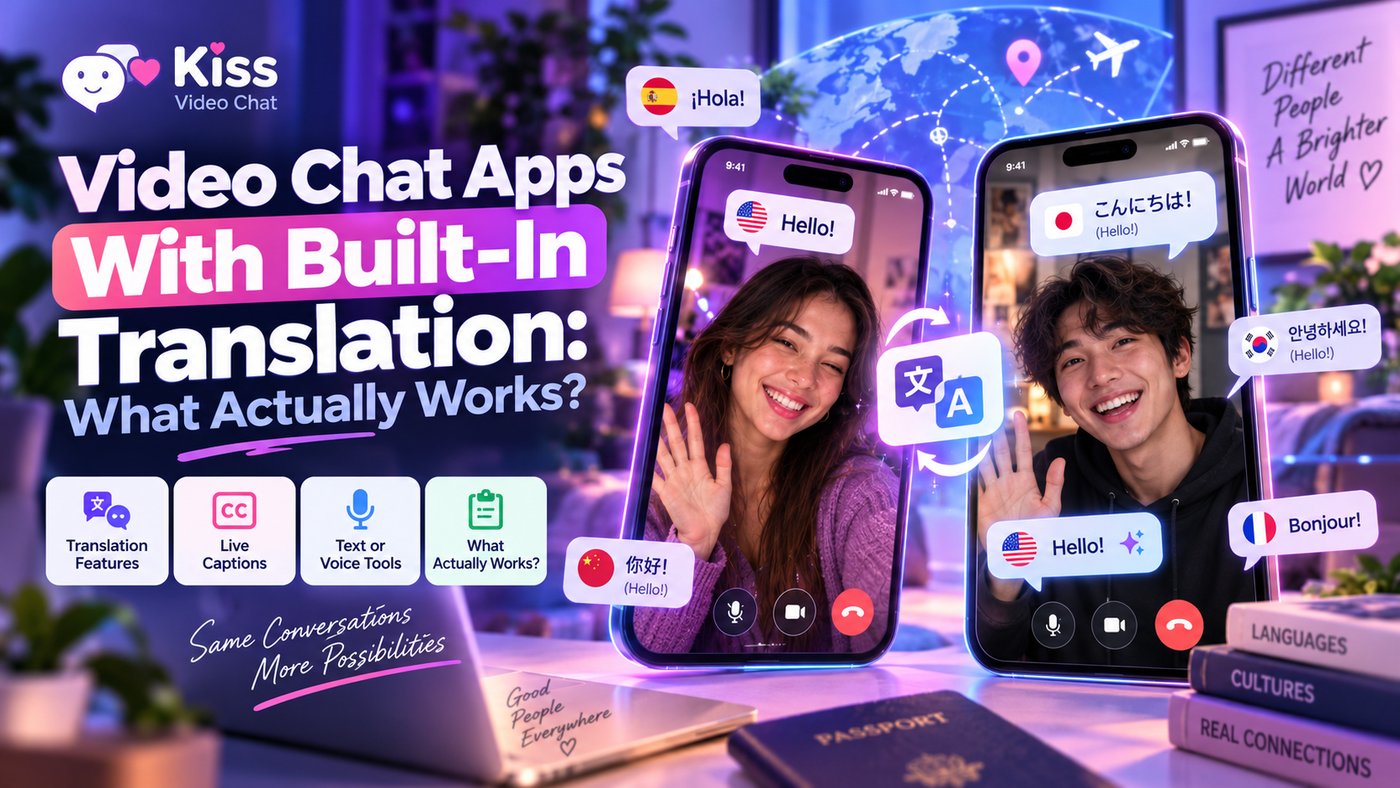
Meeting people around the world sounds exciting until you discover that you don't share a language. Built-in translation can help, but the phrase covers very different tools: translating typed messages, translating captions, or translating spoken audio in real time. A platform that supports one should not be advertised as supporting all three.
Start by identifying the translation type
Text translation helps when two people type in different languages. It can be useful alongside a video call, but it does not automatically translate speech.
Captions or subtitles turn speech into text and may require separate language recognition and translation. Accuracy can vary with accent, noise and slang.
Real-time speech translation is the most demanding capability. Unless a product clearly documents it, do not assume a generic “translator” means both people can talk naturally in their own language with dubbed audio.
What the video-chat services publish
CooMeet mentions an automatic translator for messages on its official website. That supports a claim about text assistance, not a guaranteed live interpreter for spoken calls.
Azar officially documents text-message translation and a newer Live Translation capability that converts speech to translated subtitles during video chat. Its help center notes that device and operating-system availability can vary. These subtitles should not be confused with real-time voice dubbing.
Kiss Live Chat lists profile languages and interests as part of its browse-first experience. That can help you find someone who speaks a language you know, but its public site does not establish built-in speech translation. Do not label it a translation app on that basis.
A practical alternative to translation
Sometimes matching by language is simpler than translating every sentence. Search for someone who speaks English, Turkish, Hebrew or another language you are comfortable with. Start with an easy question about language preferences, and switch to text if the conversation becomes difficult.
Treat machine translation cautiously for addresses, payments, consent and other details where misunderstandings matter. It can support friendly introductions; it should not replace clear communication in consequential situations.
Azar's Live Translation is more specific than a generic label
Azar's official help center now describes Live Translation as speech-to-text recognition followed by machine translation into subtitles during a video chat. It notes that availability and data-processing details vary by device and operating system. This is subtitle translation, not evidence that the app produces a spoken dubbed voice in every language. Azar also documents a separate text-message translation feature.
The company says it processes speech with user consent for Live Translation and explains how consent can be withdrawn in settings. That privacy dimension matters because live speech recognition handles conversational content. Before enabling the feature, read Azar's Live Translation guide and confirm what is stored or processed in your jurisdiction. Be precise when comparing translation tools: translated text, translated subtitles and dubbed speech are not the same thing.
For international conversations, try Kiss's discovery experience and select a language that makes the first hello comfortable.
A few more answers
Frequently asked questions
Does text translation mean spoken translation?
No. These are distinct capabilities.
Does CooMeet mention automatic translation?
Yes, its official site describes automatic translation of messages.
Can I meet people by language without a translator?
Yes. Kiss Live Chat describes language details during profile discovery.