Introduction
Random video chat without registration appeals to a simple instinct: you want to talk to someone new without creating another account first. No profile to build, no password to remember, and no email verification before you even know whether you like the service.
That lower barrier can make random chat feel more spontaneous, but “no registration” should not be confused with “no data,” “no permissions,” or “completely private.” The platform still needs enough technical information to create the connection, operate the session, and handle abuse, so it helps to understand what no-signup access actually changes.
Quick Answer: What Does “No Registration” Mean?
No-registration random video chat generally means you can reach the matching flow without creating a persistent user account. You may still need to grant camera and microphone permission, confirm age or terms, and allow the service to process technical data needed for the session.
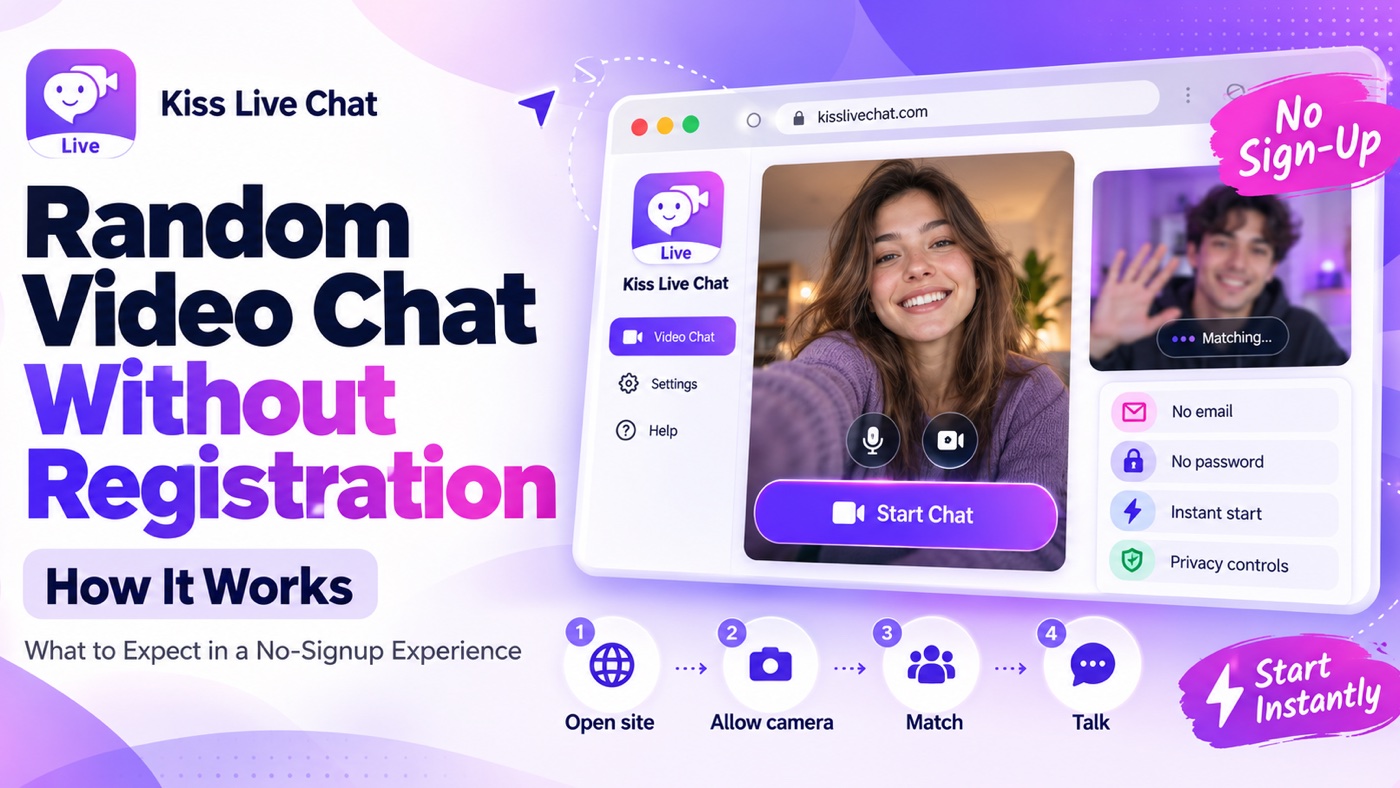
A typical flow is short enough to understand at a glance: Open the site → allow camera/mic → confirm age or terms → press Start → get matched. The fewer extra steps inserted before matching, the closer the product feels to classic low-friction random chat.
That is different from an account-based product where a profile, email, phone number, or social login becomes part of the experience before matching begins.
No Registration, Guest Mode, and Anonymous Accounts Are Not the Same Thing
These terms are often used interchangeably, but they can describe different product designs. No registration usually means you can use the core service without creating a persistent account at all. Guest mode may mean the same thing for the first session but offer an optional account later for saved contacts, history, or profile features.
An anonymous account is different again. You may still create a persistent identity with a username or password even if the service does not require your real name. That account can support preferences or reputation while keeping public identity limited.
The distinction matters because the privacy and convenience tradeoffs change. A true guest session may disappear when you close the tab, while an anonymous account can persist across visits.
Why People Prefer No-Signup Random Chat
The biggest advantage is speed. You can decide whether you enjoy the format before spending time on a profile, and there is less psychological commitment because nothing needs to be maintained after the conversation ends.
No-signup access also works well for people who want temporary interactions rather than another social identity. Language practice, casual conversations, curiosity about people in other countries, and low-pressure social discovery all fit naturally into this model.
The tradeoff is that features based on persistence may be weaker or unavailable. Friend lists, match history, profile reputation, saved preferences, or reconnect features usually need some form of identity to work reliably.
What Happens From Page Load to First Match?
The first step is usually camera and microphone permission. Modern browsers control those permissions at the browser level, so you should see a clear prompt before the service can use either input. The second step may be an age or terms confirmation, especially on adult-only services.
After that, the platform places you into a matching queue or sends a request to its matching system. Once another compatible user is available, both sides are connected in a live session. When either person presses Next or leaves, the session ends and the product returns to matching.
The exact technical architecture varies by service, but the user experience is designed to feel immediate. That simplicity is the main reason no-signup chat remains attractive.
No Registration Does Not Mean No Permissions
A browser still needs access to the camera and microphone for live video to work. That permission is separate from creating an account, and users should treat it carefully.
A normal video chat service has an obvious reason to request camera and microphone access. Requests for unrelated permissions deserve more scrutiny because location, contacts, notifications, or other device capabilities are not automatically required for a basic random chat session.
If you accidentally deny camera access, you can usually change the permission in the browser settings. A well-designed service should explain that clearly instead of leaving you with a blank video window.
What Data Can Still Be Processed Without an Account?
No signup does not mean the platform has no technical information. A service may process an IP address, device or browser information, session identifiers, cookies, abuse reports, or payment data if you purchase an optional feature.
The exact data handling differs by service, so the privacy policy is more informative than broad marketing claims such as “100% anonymous.” In many products, anonymous refers primarily to what other users see rather than the absence of all technical data.
Your own behavior matters just as much. Sharing your full name, workplace, school, home area, private social account, or other identifying details can undo much of the privacy benefit of having no public profile.
No Signup vs Account-Based Video Chat
Account-based platforms can support stronger persistence: saved contacts, match history, profile identity, reputation systems, verification, personalized recommendations, or longer-term relationships. That can be useful when you want more than a temporary conversation.
No-signup services trade some of that structure for speed. They make the most sense when you value immediate access, minimal setup, temporary interactions, and limited public identity.
The useful question is whether you want a conversation or a social account. Those are related products, but they are not the same thing.
Is No-Registration Video Chat Safer?
Not automatically. Account requirements can create more accountability in some systems, while no-signup services can reduce the amount of persistent identity attached to a session. Both designs can have strong or weak moderation.
Look instead at concrete safety controls: skip, report, block where available, visible age rules, community guidelines, and how quickly you can leave an uncomfortable interaction. Our guide to random video chat safety goes deeper into those risks.
Safety depends on platform design and user behavior, not simply whether an email address was required. A no-signup product can have strong moderation, while an account-based product can still expose users to poor interactions if its controls are weak.
When No Registration Is the Right Choice
No-signup random chat makes sense when you want a low-commitment way to meet someone new, you are testing a service before deciding whether to use it regularly, or you prefer not to maintain another public social profile. It can also be a good fit for occasional desktop or browser use.
It is less suited to users who want durable contacts, extensive personalization, strong profile verification, or a history that follows them across sessions. In those cases, an account-based product may offer more useful structure.
The best choice depends on what you want to happen after the conversation ends. If you want the session to disappear, guest access is attractive; if you want continuity, an account gives the product more ways to remember you.
Conclusion
Random video chat without registration removes one major source of friction: the account. That can make the experience faster, lighter, and more spontaneous, especially when you only want a conversation rather than a persistent social identity.
No signup should not be mistaken for complete anonymity or automatic safety. Camera permissions, technical data, moderation, and personal behavior still matter. The best no-registration experience combines a short startup flow with clear privacy information, fast safety controls, and no pressure to reveal more about yourself than the conversation actually needs.