
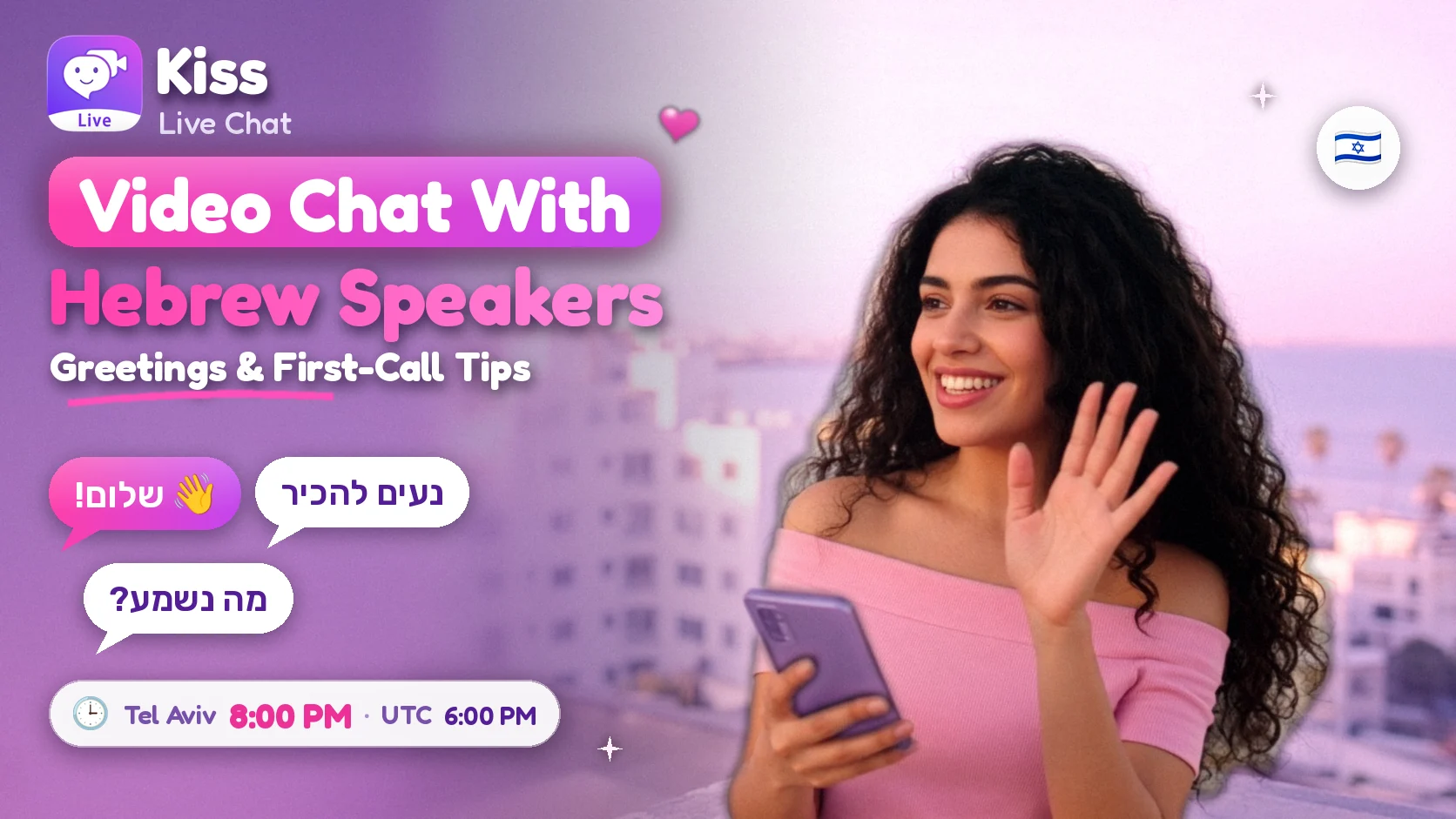
A first video call in another language can feel much harder than a first written message. There is no time to look up every word, you may be unsure how to pronounce a greeting, and silence can feel more noticeable when someone is looking back at you on camera. The good news is that a short, friendly conversation in Hebrew does not require perfect grammar. One natural hello, a clear explanation of what you want and the willingness to listen are usually enough to get started.
This guide is for adults who want to meet Hebrew speakers online, practice everyday spoken Hebrew or learn more about a person who may live in Israel or elsewhere. It focuses on actual phrases, a simple first-call structure and time-zone planning. It does not assume that everyone from Israel speaks Hebrew as a first language, or that Hebrew speakers share the same culture, views or personal background.
Quick answer
Start with שלום — shalom (hello), follow with מה נשמע? — ma nishma? (how's it going?), and ask what language both of you are comfortable speaking. If you're a beginner, say that openly. Use one easy topic, such as music or food, and ask for a repetition when needed. Choose a service with language or country preferences, but treat these as discovery tools, not guarantees of a Hebrew-speaking person on the next call.
First: country, language and identity are different things
Hebrew is widely spoken in Israel and in communities abroad, but speaking Hebrew does not reveal anyone's nationality, religion, political views or personal history. Likewise, a person in Israel may prefer Arabic, English, Russian, Amharic or another language. A country setting is not a language certification.
On video chat, ask rather than assume: 'Would you rather speak Hebrew or English?' If the other person prefers English, that is not a failed match. It might be a better conversation than a forced language exercise.
Useful Hebrew phrases for your first call
Hebrew is written from right to left. The transliterations below are rough pronunciation aids, not precise phonetic notation. Actual vowels and accents vary, and a native speaker can help you hear the difference. Some Hebrew verb forms change with the speaker's gender, which is why alternatives appear in a few rows.
| Hebrew | Approximate pronunciation | English / usage |
|---|---|---|
| שלום | shalom | Hello; also peace |
| היי | hai | Casual hi |
| מה נשמע? | ma nishma? | How's it going? |
| נעים להכיר | na'im lehakir | Nice to meet you |
| תודה | toda | Thank you |
| בבקשה | bevakasha | Please / you're welcome, depending on context |
| אני לומד/לומדת עברית | ani lomed/lomedet ivrit | I'm learning Hebrew (form varies with speaker) |
| אפשר לדבר קצת יותר לאט? | efshar ledaber ktzat yoter le'at? | Can you speak a little more slowly? |
| אפשר לחזור על זה? | efshar lakhzor al ze? | Can you repeat that? |
| אני לא מבין/מבינה | ani lo mevin/mevina | I don't understand (form varies with speaker) |
| להתראות | lehitraot | Goodbye / see you |
| לילה טוב | layla tov | Good night |
For the first attempt, do not memorize every row. Choose four: hello, how are you, please speak more slowly and thank you. Being able to ask for clarification will keep the chat alive longer than reciting a long prepared speech.
A small pronunciation note
The Hebrew letter ח can represent a sound that does not line up neatly with English 'h'. You may hear different approximations of words depending on the speaker. Do not let that stop you from speaking. If a phrase lands awkwardly, laugh politely and ask 'Could you say it once more?' That is a normal part of learning.
For names, ask the person how to pronounce theirs rather than guessing from transliteration. A name in a profile could also be stylized or abbreviated, so never insist on a legal name.
A first-call script that doesn't sound like a classroom
Imagine you have just been connected with someone who speaks Hebrew. Keep the conversation easy:
You: 'Shalom! Ma nishma?'
Them: They answer in Hebrew, perhaps quickly.
You: 'I'm just learning Hebrew. Can we speak a little slowly? I'm happy to use English too.'
Them: They choose a language or teach you a word.
You: 'Thanks. What have you been listening to this week? I found a new song yesterday.'
The last line is the important one. You stop treating the other person as a free language lesson and begin talking about something you both may enjoy. If the answer is 'I'm not into music', pivot naturally: 'No worries—what do you do to relax?' A video call should feel like a conversation, not an interview.
Five conversations that work across languages
1. A song someone keeps replaying
Music titles can be typed in the chat if the spoken word is difficult. Ask for one favorite rather than demanding a list of local artists. Share your own answer and say why you like it.
2. A place they like, without asking their address
'Is there a nice café, park or view where you live?' invites a description. Do not follow up with requests for exact neighborhoods, workplaces or current locations. Their privacy matters as much as yours.
3. A recent good meal
Food vocabulary is concrete and easy to learn. Ask what they ate recently, not what every person in their country supposedly eats. If they describe a dish, ask what ingredients make it special.
4. An ordinary evening
'What do you usually do to relax after a long day?' works even if neither person has advanced vocabulary. Respond to the answer with a small story about yourself. Reciprocity is the secret to keeping a call moving.
5. Teach each other one useful expression
Ask for a phrase that people actually say among friends. Then offer a similar casual expression in your own language. If pronunciation becomes funny, laugh with the person, never at their accent.
What time should you call someone in Israel?
As of November 23, 2026, Israel is on standard time, UTC+2. It switched from daylight time on October 25, 2026; daylight time will return in March 2027. During the daylight-saving season Israel is UTC+3. The 2026 Israel clock-change reference lists the seasonal change. This is different from Turkey, which stays UTC+3 year-round.
For a convenient example, take 8:00 PM in Tel Aviv on November 23, 2026:
| Location | Local time at that moment |
|---|---|
| Tel Aviv | 8:00 PM (UTC+2) |
| UTC | 6:00 PM |
| London | 6:00 PM (winter GMT) |
| New York | 1:00 PM (EST) |
| Los Angeles | 10:00 AM (PST) |
| Istanbul | 9:00 PM (TRT) |
These are time-zone conversions, not claims about peak online traffic in Israel. If you meet a good conversation partner, ask their preferred time. Many Hebrew speakers live in other countries, so their actual local time matters more than an assumed location.
An eight-minute practice call, minute by minute
Minute 1: greeting and consent. Say shalom, introduce yourself briefly and ask which language would be comfortable. If someone does not want to practice Hebrew, accept that.
Minutes 2–3: familiar topic. Choose a song, film or meal. It is easier to describe something visible or specific than to debate abstract issues in a language you are still learning.
Minutes 4–5: one new word. Ask 'How do you say that in Hebrew?' or 'Could you type the word for me?' Repeat it once and use it in a simple sentence. You do not need to memorize ten words.
Minute 6: give back. Let your partner choose a topic or practice a phrase in your language. This is a conversation between equals, not an unpaid tutoring session.
Minutes 7–8: close with intention. Say thanks and a friendly goodbye. If both want to talk again, arrange it through the platform's supported tools rather than immediately exchanging personal numbers.
What if your partner speaks too quickly?
You can say efshar ledaber ktzat yoter le'at? or simply ask in English for slower speech. If the audio quality is poor, don't assume you are failing to understand Hebrew; it could be a connection issue. Ask the person to repeat once, then try typing a word. Short questions reduce the chance of both people talking over each other.
Finding Hebrew speakers through Kiss Live Chat
Kiss offers adults aged 18+ non-explicit one-on-one conversations with female hosts. In the browser you can browse online profiles and choose whom to call, or use optional Video Match. Use the available language/country preferences only as discovery aids; do not assume there is a dedicated Hebrew option. No preference guarantees that someone will speak Hebrew, live in Israel or want language practice. Ask respectfully and move on politely when interests differ.
Use the official Kiss Web entry. Each new one-on-one call includes 60 free seconds; continuing that call uses coins. Check the current rate on the call screen. The site describes reporting and blocking controls. Keep video chat respectful and leave immediately if someone ignores your boundaries.
If you want a broader introduction to language exchange on video, see practice a language with native speakers. This article focuses on Hebrew phrases, writing direction and Israel's seasonal clock changes.
Respectful chat matters more than flawless grammar
There is a difference between curiosity and putting someone on the spot. The person you meet is not required to explain a country's politics, faith, military service or social tensions to you. If a sensitive topic arises naturally and both people are willing to talk, listen respectfully; otherwise, choose something easier. A first call works best when the other person can choose how much to share.
Do not use video chat to test someone's identity, collect private information or ask for political statements. Language preference is not permission for personal interrogation.
Safety and privacy on your first call
Keep identifiable paperwork, family photos, address labels and work information out of the camera frame. Never send verification codes, payment information or private documents. Do not give someone money or transfer a conversation to a suspicious site because they say it is required to unlock further chatting. Report harassment or deception with the platform's tools and end the call when you want.
If you want to remain in touch, remember that a good first conversation does not create an obligation for the other person to respond again. Mutual interest matters more than urgency.
A small start is enough
You do not need a perfect accent, a long vocabulary list or a clever line. 'Shalom. Ma nishma?' followed by a genuine question is a good start. If you are ready for a real-time conversation, open Kiss Live Chat, use relevant preferences and give the other person room to be themselves.
Quick answers
Frequently asked questions
Where can I talk to Hebrew speakers online?
Adults can use language exchanges or video chat platforms with relevant preferences. Country preferences may help but do not guarantee Hebrew-language matches. Ask which language the person wants to use.
What does 'shalom' mean?
It is a common greeting meaning hello and can also mean peace. It is an easy, broadly recognized way to begin.
Is spoken Hebrew hard for English beginners?
Some sounds and grammatical forms may be unfamiliar, but a short exchange can begin with a few greetings and clarification phrases. Listening and repeating respectfully matter more than perfect pronunciation.
Does Israel use the same time all year?
No. Israel is UTC+2 during standard time and UTC+3 during daylight saving time. Confirm the season before arranging calls across time zones.
Does Kiss translate spoken Hebrew automatically?
Do not assume a particular translation capability from a generic product description. Use the currently available interface and its feature labels; language preferences alone are not voice translation.
Is it okay to ask someone from Israel about their religion or politics?
Do not assume that nationality, language or location determines a person's beliefs. First ask whether they want to discuss a sensitive topic, and respect a no.