
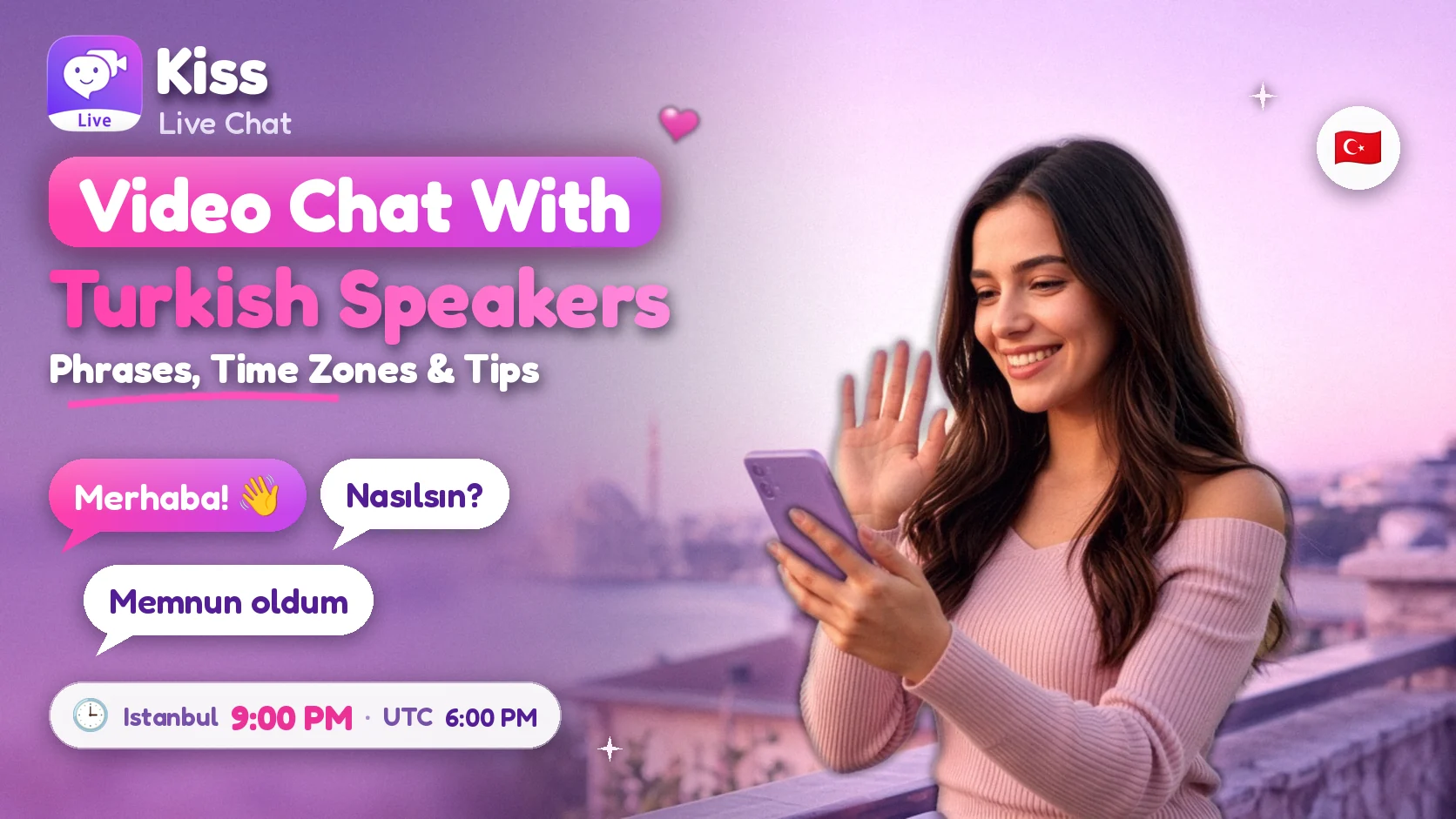
If you want to speak Turkish more naturally—or simply meet someone who lives in Turkey—live video chat gives you something a textbook does not: a real person, real pauses and the little details that make a conversation feel human. You hear how somebody says hello, watch their expression when they tell a story and learn what to ask next instead of rehearsing the same introduction over and over.
The difficult part is usually not the technology. It is finding someone who actually wants to talk, choosing a good time across time zones and knowing how to begin without turning the call into a language exam. This guide gives you a practical approach and a set of Turkish phrases you can actually use in a first call.
Quick answer: choose an adults-only video service with language or country preferences, check the time in Turkey, begin with 'Merhaba' (hello), say whether you are practicing Turkish or just meeting people, and follow one question with one real detail about yourself. The goal is a good exchange, not a perfect accent.
Start by choosing the right kind of conversation
There are different reasons to talk with Turkish speakers online, and each calls for a slightly different approach.
- Language practice: you want patient correction, slower speech and maybe a language exchange.
- Making friends: you want to trade stories about music, daily life, food and hobbies without making every call feel like homework.
- Learning about culture: you want to hear individual experiences, not ask one person to represent an entire country.
- A spontaneous chat: you simply want to meet a new person and see where the conversation goes.
State your intention early. 'I'm learning a little Turkish. Would you mind if I practiced two sentences?' gives the other person a choice. 'Are you from Turkey? Tell me everything about Turkish people' puts them in an awkward position.
A country preference may help find someone associated with Turkey, but it does not guarantee that the person is a native Turkish speaker. Turkish is also spoken outside Turkey. Ask rather than assume.
Turkish phrases for a first video call
These are everyday, generally informal phrases. The table gives meanings and usage, not a pronunciation guide; listening to a speaker is more reliable than guessing from spelling.
| Turkish | English | When to use it |
|---|---|---|
| Merhaba | Hello | Safe, neutral first greeting |
| Selam | Hi | More casual opening |
| Nasılsın? | How are you? | Friendly, informal |
| İyiyim, teşekkürler. Ya sen? | I'm well, thanks. And you? | Natural follow-up |
| Memnun oldum | Nice to meet you | After introductions |
| Türkçe öğreniyorum | I'm learning Turkish | Sets expectations kindly |
| Biraz Türkçe konuşabiliyorum | I can speak a little Turkish | Useful if you're a beginner |
| Biraz daha yavaş konuşabilir misin? | Could you speak a little more slowly? | When you need time |
| Tekrar eder misin? | Could you repeat that? | When sound or vocabulary is unclear |
| Bu ne demek? | What does this mean? | Ask about a new word |
| Hobilerin neler? | What are your hobbies? | Moves past 'How are you?' |
| Görüşürüz | See you | Friendly closing |
The letter ı (dotless i) and ğ may be unfamiliar to English speakers. It is fine to type a word in the chat and ask someone to pronounce it. What matters most is not making every sound perfectly; it is letting the other person know you are listening.
A natural 30-second opening
Try a short sequence instead of reciting ten memorized lines:
'Merhaba! Ben biraz Türkçe öğreniyorum. İngilizce konuşmak ister misin, yoksa biraz Türkçe deneyelim mi?'
This means roughly, 'Hello! I'm learning a little Turkish. Would you like to speak English, or shall we try a bit of Turkish?' It gives the other person options and makes your intention clear without pressuring them to teach.
If they are not interested in a language exchange, switch to a normal friendly conversation or say goodbye. Being rejected as a conversation partner is not a verdict on your language skills.
Four topics that tend to be easier than small talk clichés
Music: 'What have you been listening to this week?' invites a genuine answer without suggesting that everyone in Turkey listens to the same artists. You might discover Turkish rock, indie pop, electronic music or something completely different.
The city they know: 'What's a place near you that you like to spend time?' is better than 'What's the best city in Turkey?' You can mention a park or café in your own city to make it reciprocal.
Food you both like: Rather than treating cuisine as a tourist quiz, ask what they actually cooked or ate recently. Share something from your own kitchen as well.
How people spend a free evening: Games, films, football, reading, concerts and daily routines all work. Avoid assuming everybody cares about sports, politics or religious traditions.
When someone mentions an interesting detail, follow that thread. If they say they like photography, ask what they enjoy photographing. That will produce a better conversation than checking off a prepared list of fifty questions.
What time is best for a call with someone in Turkey?
Turkey uses Turkey Time (TRT), UTC+3 all year, without switching for daylight saving time. That makes planning simple on Turkey's side. The complication comes from your own local time zone, especially if you live somewhere that changes clocks seasonally.
The examples below use offsets applicable on November 23, 2026. Turkey's time-zone reference explains the year-round UTC+3 setting. Always check your local clock around daylight-saving transitions.
| When it is 9:00 PM in Istanbul | Local time in... | Note |
|---|---|---|
| UTC | 6:00 PM | Turkey is three hours ahead |
| London | 6:00 PM | UK winter time, GMT |
| New York | 1:00 PM | US Eastern Standard Time in November |
| Los Angeles | 10:00 AM | US Pacific Standard Time in November |
| Tel Aviv | 8:00 PM | Israel winter standard time |
These are scheduling conversions, not claims about when Turkish users are most active on any platform. Choose a time that works for two real people. If you find someone you enjoy talking to, ask 'What time of day is usually good for you?' rather than assuming they are online every night.
A practical 12-minute first-call plan
You do not need to spend an hour speaking a language you are still learning. A short call with a clear shape is often easier.
Minutes 0–2: greetings. Say hello, introduce yourself with only the level of detail you are comfortable sharing and ask what language works for both of you. Avoid requesting a surname, exact address or social handle.
Minutes 2–5: one simple topic. Music or how the person's day has been is enough. Make a real contribution: 'I was listening to an old album on the train today.' That gives the other person something to respond to.
Minutes 5–8: use one Turkish rescue phrase. Ask the person to slow down or repeat a word. If they want corrections, agree to receive only a few, rather than stopping the conversation every sentence.
Minutes 8–10: switch roles. Offer English conversation or ask what the other person would like to practice. An exchange should not feel like unpaid tutoring.
Minutes 10–12: finish naturally. Thank them for the conversation. If both of you want another call, agree on a rough time using the platform's supported contact tools. Otherwise, a polite 'Görüşürüz' is enough.
Using Kiss Live Chat to meet Turkish speakers
Kiss Live Chat is for adults aged 18+ and non-explicit conversations with female hosts. Browse online profiles and choose whom to call, or use optional Video Match. Language and country preferences can help you discover Turkish-speaking hosts, although no setting can promise a Turkish-speaking person will be online or accept a call at a particular moment.
To get started, open Kiss Video Chat, read the eligibility and safety rules, allow camera and microphone permissions if you are comfortable, and select available preferences. Each new one-on-one call includes 60 free seconds; continuing that call uses coins. Read the call's current rate before paying.
For a more general method that works with any language, see How to Practice a Language With Native Speakers on Video Chat. For a platform shortlist, see Turkish Video Chat Apps. This article is about Turkish-specific phrases, timing and the flow of a first conversation.
Language learning without turning strangers into teachers
The best approach is to invite, not demand. Some people love explaining words; others are only there to relax. Say 'I know a little Turkish; would you like to try?' and accept whichever answer you get. If someone teaches you something, thank them, then ask a normal question. That keeps the relationship from becoming a one-way lesson.
Be cautious about assumptions. A Turkish-speaker may be from Germany, Cyprus, the UK or elsewhere; country and language are not interchangeable. Avoid turning culture into a test: 'Do you all do X?' is usually worse than 'What's that like for you?'
Privacy and boundaries across countries
You do not need to give a phone number or Instagram handle to prove you are friendly. Keep first conversations inside the platform if possible. Avoid disclosing your full name, employer, exact neighborhood or travel itinerary. Video provides more cues than text, but somebody can still record a screen or misrepresent their identity. Use available report, block and end-call tools when necessary.
If a person asks for money, immigration help, gift cards or access to your accounts after a brief introduction, stop and report the interaction. Cross-border friendliness is not a reason to make financial commitments to a stranger.
The goal is not perfect Turkish
A good first call might contain two Turkish words, a little English, an unfamiliar song recommendation and a shared laugh. That still counts as a useful conversation. Prepare three phrases, check Turkey's clock, stay curious about the individual in front of you and let the exchange happen at its own pace. When you're ready, try a one-on-one call on Kiss.
Quick answers
Frequently asked questions
Can I meet Turkish speakers through random video chat?
Yes, a video chat service with language or country preferences may help you discover Turkish-speaking participants, but it cannot guarantee language or availability in every match.
Do I have to speak Turkish to start?
No. Say hello in a language you both understand and ask whether they would enjoy practicing a little Turkish or English. Respect their answer.
What's an easy Turkish greeting for video chat?
'Merhaba' is a useful, broadly appropriate hello. 'Selam' is more casual. Follow with a small question rather than a long memorized introduction.
Does Turkey change clocks in summer?
No. Turkey currently uses UTC+3 year-round. Your own location may change its offset, so recheck when scheduling across countries.
Is Kiss specifically a Turkish-only video chat app?
No. Kiss is an international adult video chat service. Language and country preferences are discovery aids, not guarantees about who is online.
Is it safe to give someone my WhatsApp number after the first call?
There is no obligation to share off-platform contact details. For early conversations, keeping boundaries and using the product's available communication tools is usually more prudent.